


How do financial institutions hedge against inflation in Nigeria
8/29/2022

The National Bureau of Statistics recently estimated inflation at 18.6% year-on-year in June -2022. In instances of extremely high inflationary pressures. Businesses or individuals can use various financial instruments or products to hedge against inflation.
Below we review various asset classes, and we highlight several tools that can use to hedge against inflation. We examine how these fare against inflation in the Nigerian market.
Risk-free instruments and alternative Assets
In most markets, sovereign bonds (bonds issued by the government) are the ultimate tool to hedge inflation. As usual, the idea is that a government borrows money for a period of time at no risk to the lender. However, the borrower must compensate the lender for the money lost due to the rise in price levels, fulfilling the time value of money considerations. In other advanced economies, such as the U.S Market, the US Treasury issues papers such as TIPS, which are inflation-adjusted, to hedge against inflation.
In the absence of any of these products in the Nigerian market, investors have had to rely on alternative savings/investments to protect themselves against inflation. However, in Nigeria, due to significant headwinds which have plagued the financial system and economy, the relationship or perception that investment returns are higher than inflation does not necessarily hold. As in the Nigerian economy, these things are usually not as precisely as they ought to be.
Earlier, we have spoken about how Gold remains a powerful instrument as a store of value; even in a volatile era since the pandemic, it has remained steady compared with other financial instruments.
A review of various asset classes is available to the average and potential retail investors. Our analysis compared the average annual inflation in a given year from 2015-2021. During this six (6) year period, we found that in most years, the New ETF and 354-day treasury bill paper outperformed the average inflation.
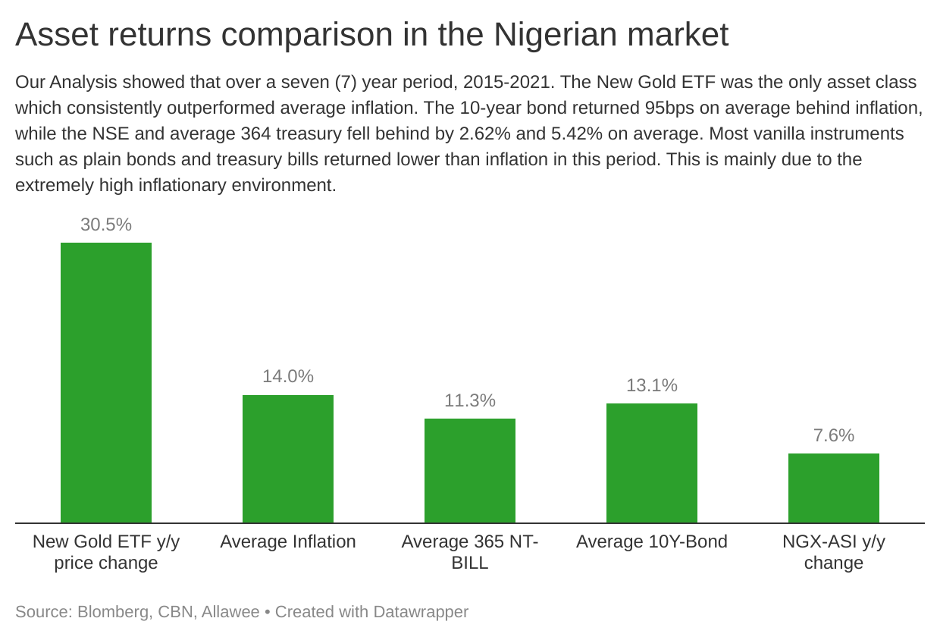
This indicates that the New Gold ETF would have outperformed average inflation in most years. Our analysis highlights that over a seven (7) year period, the New ETF is the only asset class that has consistently outperformed the average inflation in this period. The 10-year bond lies on the average 95bps behind inflation, whilst the NSE and average 364 treasury fall behind by 2.62% and 5.42% on average.
Most vanilla instruments such as plain bonds and treasury bills return lower than inflation in this period. This is largely due to the extremely high inflationary environment. However, Fintech, asset management and other alternative financial assets within Nigeria's macroeconomy usually offer above-inflation returns as they are pooled instruments from riskier assets combined with sovereign instruments.